A daily practice, for a very long time
Across South Asia, massaging a baby is simply part of the day. Not a treatment, not a trend — something that happens every evening in most houses, and has done for generations.
In the last few decades it arrived in the West as something else: a wellness practice, sold to new parents alongside sleep trackers and feeding apps, usually without any mention of where it came from.
We think that's a shame. A tradition doesn't survive by being repackaged — it survives by being lived, practised, and honest about where it began.
Nearly every baby in India is massaged
It usually starts in the first week of life, often twice a day, and it carries on for months. In most homes it happens after the bath or before sleep, in the same order every time, with warm oil and a lot of low talking.
Nobody learns it from a book. You learn it because you grew up watching it — an aunt on the floor with her legs out straight, a baby along her shins, the whole room arranged around the fact that this is what happens now.
It's near-universal in India, Bangladesh and Nepal. Not as a revival, and not as anything anyone thinks of as heritage. It simply never stopped.
Who actually does it
Traditionally, women. The mother, the grandmother, an aunt, or a woman who comes to the house for the weeks after the birth and knows more about newborns than anyone you've met.
In practice now, it's whoever is there. The mother or the father. An uncle on a Sunday. Grandparents visiting for a month. The hands matter more than whose they are.
What doesn't change is how it's learned — from someone in the room who already knows.
That's the gap we built this for. Plenty of parents want to do this and simply have nobody nearby to show them. What's available instead is the Westernised version, taught as a technique. We'd rather teach the traditional one, properly, to anyone who wants it.
If you're doing this without them
Here's the thing about a practice passed down by hand: it only survives if the people are in the room.
A lot of us moved. For university, for work, for a better life — across a city or across an ocean. It was the right decision and most of us would make it again.
But some things don't survive the journey. Recipes go. Songs go. And the small physical knowledge of how to look after a baby — the things nobody writes down because nobody ever needed to — those go first, because they were never in a book to begin with.
If you grew up watching your mother or your aunts do this, and now you're four thousand miles away with a baby who won't settle and a phone full of apps telling you to log the feed, you already know what's missing.
That's what this is for. Not a course. Not a certificate. Just the thing she would have shown you, if she were here.
And if none of this is your heritage at all — you're welcome to it anyway. That's how it has always travelled.
It was written down a long time ago
Infant massage appears in the classical medical literature of Ayurveda — in Kaumarabhritya, its branch dealing with children, and above all in a text called the Kashyapa Samhita, the main surviving work on the subject. The practice has a name there: shishu abhyanga, infant oil massage.
What those texts describe is gentler than you might expect. Warm oil, never hot. Slow hands. Begin once the baby is settled. Do it daily, with attention.
It was written down in classical medical texts, and families have been doing it ever since.
How it reached the West
In 1973 a young American woman named Vimala McClure was working at an orphanage in northern India. She watched the women there massage the babies every day. On her way out of the country she saw a young mother at the roadside oiling her baby, and it stayed with her.
She went home to the United States, taught it to parents from her front room, published a book in 1978, and built a training course. The organisation that grew out of it now reaches around seventy countries.
Around the same time a French obstetrician, Frédérick Leboyer, published a book of photographs of an Indian woman massaging her baby. He titled it after her: Shantala. Nobody recorded who she was.
Almost every baby massage class in the West traces back to those two moments. That's how it travelled, and both women who taught it were Indian.
Since then interest has grown steadily. Over the last twenty years researchers have studied it seriously — including large trials in Bangladesh, India and Nepal, run in the places where the practice already existed — and what they found has pushed it further into the mainstream.
Which is a good thing. We'd just like the families it came from to have the tradition back in their own hands.
That's what we're building: a way for young families with this in their background to learn it as it's actually done, rather than the version that came back to them second-hand.
You probably called her something else
Nani is the Hindi word for your mother's mother. That's what I called mine. It's one word out of a great many.
- Nani Hindi, Urdu
- Dadi Hindi, Urdu
- Aaji Marathi
- Ajji Kannada
- Paatti Tamil
- Ammamma Telugu
- Ammumma Malayalam
- Didima Bengali
- Thakuma Bengali
- Ba Gujarati
- Bebe Punjabi
- Aachchi Sinhala
- Hajurama Nepali
And that's before whatever your family actually used at home — the one nobody else's family would recognise.
The word was never the point. The point is that she knew how to do this, and most of us are now raising children somewhere she isn't, in a life she might not entirely recognise, still wanting to give them the thing she gave us.
Whatever you called her, this is the part worth carrying forward.
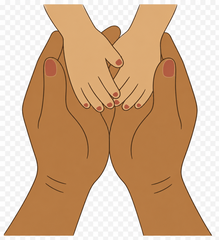
We called it Nani's Hands because that's the honest description of what this is. Not a method, not a system. Somebody's grandmother's hands, written down so they can reach further than she can. We picked one word for all of them.
Free. No email needed.