
The best oil for baby massage
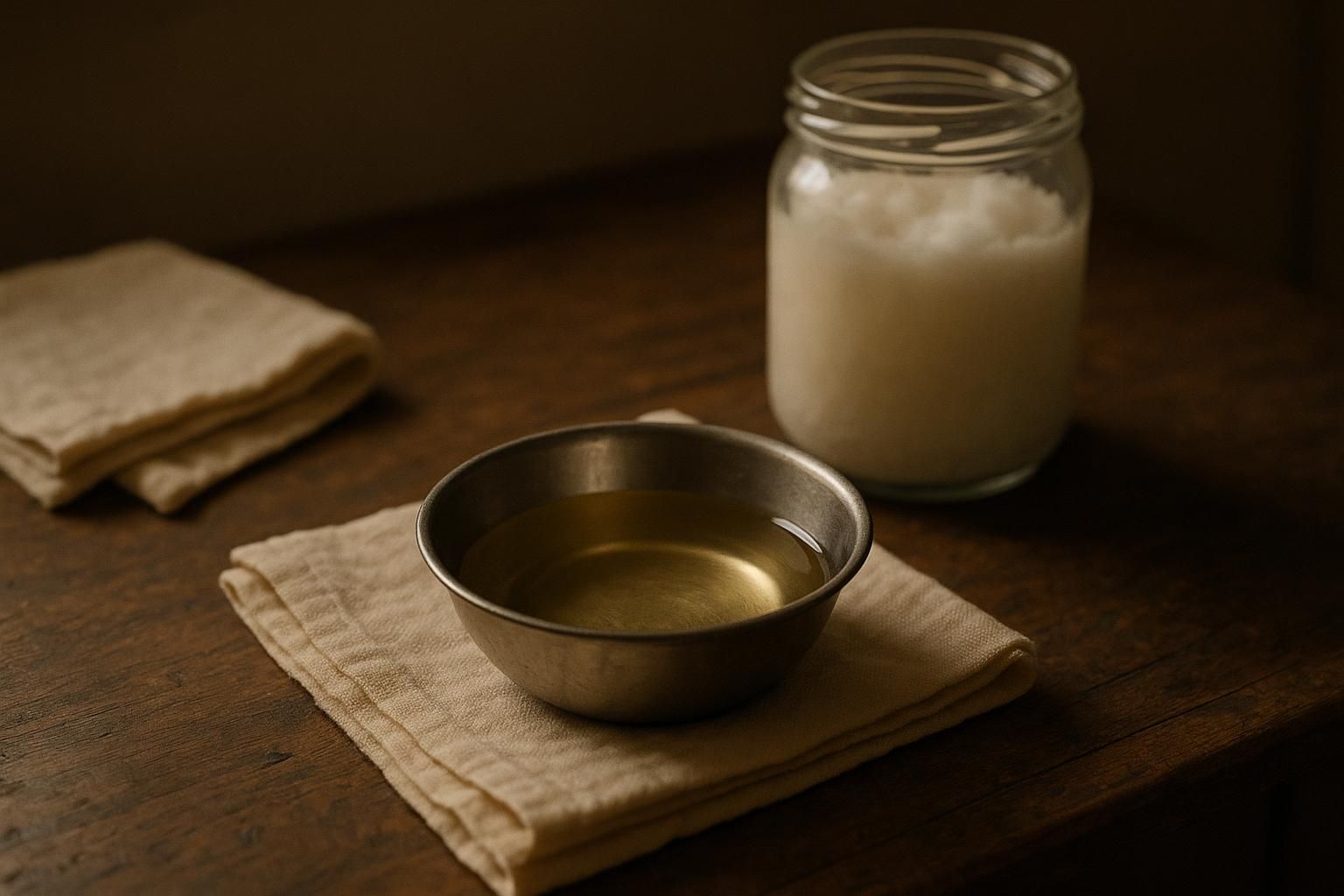
Virgin coconut oil. Fragrance-free, patch-tested, warmed between your own palms — and only after the first few weeks. That is the whole answer, and a newborn massage works perfectly well with no oil at all.
The harder half of the question is what to leave on the shelf. Two of the oils most commonly used on babies in South Asian households come out badly in the skin-barrier research, and the Indian Academy of Paediatrics advises against both.
What is the best oil for baby massage?
Virgin coconut oil, on the evidence available.
A randomised trial in 74 very low birthweight infants found that coconut oil reduced transepidermal water loss — how fast skin leaks moisture — by a mean of 6.80 g/m²/h, improved measured skin condition, and did not increase bacterial colonisation. An earlier Mumbai trial of 224 newborns found greater weight-gain velocity with coconut oil than with mineral oil or none.
Neither of those studies was run on healthy babies at home, and neither makes coconut oil a treatment for anything. What they support is narrower and still useful: as a medium for newborn massage, it does not damage the skin, and it may help it hold water.
Every other page you'll find on this question ends in a product grid. We don't have one, because the answer is a jar of virgin coconut oil from a supermarket.
Do you need to use oil at all?
No. Massage works fine dry.
Oil is a lubricant. It lets your hands move without dragging on the skin, which matters more on a newborn than on an adult, and it is genuinely pleasant. It is not the active ingredient, and no professional body positively recommends a specific massage oil for infants.
Our Night Calming routine was written to need nothing you don't already own. That was a deliberate constraint rather than a modest one — the moment a routine requires a purchase, it stops being something you can start tonight at eight o'clock.
Which oils should you avoid?
Mustard and olive, as a default. Both are traditional, both are widely used, and both perform poorly in the skin-barrier research.
Olive oil reduced stratum corneum integrity in trial conditions, and in the OBSeRvE trial of healthy term newborns it impeded the improvement in skin lipid structure seen with no oil at all. Doing nothing beat it.
Mustard oil is the harder case, and worth stating precisely. It contains allyl isothiocyanate, a known irritant, has documented contact dermatitis behind it, and delayed barrier recovery in a mouse model.
Large community trials in Nepal and Uttar Pradesh then found no clear clinical disadvantage against sunflower oil, so "mustard oil is toxic" would overstate the case. What is fair to say is that it carries plausible risk and no established advantage over gentler options — reason enough to reach for something else.
Sesame oil — til — is the classical Ayurvedic choice and one small trial found growth and sleep benefits. It is also a major food allergen, and applying food proteins to broken or inflamed skin carries a sensitisation risk. Not a default, and best avoided entirely where there is eczema or broken skin.
Naming what we leave out is the same job the safety page does. A site that only ever tells you what to add is not being cautious with you; it is being commercial at you.
Why is olive oil a problem?
Because it appears to work against the skin barrier rather than with it.
Olive oil is high in oleic acid, and a study by Danby and colleagues found that applying it to adult forearms reduced stratum corneum integrity and caused mild redness — including in people with no history of eczema. The OBSeRvE trial then tested oils on healthy term newborns and found the no-oil group's lipid lamellae improved more than the oiled groups'.
This one matters because olive oil is the single most repeated home recommendation on the internet, it is in the cupboard already, and it feels obviously harmless. It is the recommendation we get asked about most and the one the evidence is clearest about.
| Oil | Verdict | Why |
|---|---|---|
| Virgin coconut | Best default | Reduced water loss and improved skin condition in a randomised trial; greater weight-gain velocity than mineral oil in a second. The Kerala and South Indian tradition |
| High-linoleic sunflower | Acceptable, with care | The oil used in the Bangladesh hospital trials; linoleic acid supports barrier maturation. Must be high-linoleic — ordinary high-oleic cooking sunflower oil is a different product |
| Mineral oil, and most bottled baby oil | Works, adds nothing | A perfectly good lubricant with no demonstrated benefit. Coconut oil outperformed it on weight gain in the Mumbai trial |
| Sesame (til) | Not as a default | Major food allergen. Avoid entirely on eczema-prone or broken skin |
| Olive | Avoid | Reduces stratum corneum integrity; no oil beat it in the OBSeRvE trial. IAP advises against |
| Mustard (sarson) | Avoid | Contains a known irritant, documented contact dermatitis, delayed barrier recovery in animal models, and no established advantage. IAP advises against |
| Any fragranced or essential-oil blend | Avoid | Fragrance is the most common cause of contact reaction, and it is the ingredient doing the least work |
If you are holding a bottle your mother sent from home and it is on the lower half of that table, you have not done anything wrong. That gap — between what was passed to you and what the research now says — is the specific thing this site was built to sit in.
Where this comes from
Which oil was never really a decision. It was whatever was in the house, and what was in the house depended on where the house was.
Mustard — sarson — across Punjab, Bengal, Nepal and Pakistan, warmed in a steel bowl until the smell filled the room. Coconut in Kerala and down the south coast. Sesame in the classical texts and much of the country in between.
The logic behind it was seasonal: warming oils for cold months and cold regions, cooling coconut for hot ones. It is a coherent system, and in the south it arrived at the right answer by a route that has nothing to do with skin-barrier trials.
The one we leave out is the northern default. Not because your nani was careless with it — she wasn't, and a whole generation came through it fine — but because it is the one oil in the set that a paediatric body has looked at and advised against, and nothing at all is lost by reaching for the Kerala jar instead.
Bhosale et al., BMC Pediatrics, 2020; oils by regionWhat does the research on massage oil actually show?
A great deal in hospitals, and much less at home.
The strongest findings in the entire field are South Asian. In a trial of 497 preterm infants at Dhaka Shishu Hospital, sunflower seed oil massage reduced hospital-acquired infection by 41%; follow-up analysis of the same cohort found a 26% reduction in mortality.
Those are premature babies, in hospital, under supervision, to a protocol. No trial shows that oiling a healthy term baby at home reduces infection or affects growth, and we are not going to imply otherwise by putting the two next to each other without saying so.
Which is the honest boundary of what this site is. Our routine was written for a healthy, term baby on a towel in a warm room — not for the population those trials studied.
How do you choose a massage oil for infants?
Four checks, and they take a minute in a supermarket aisle.
- One ingredient. Virgin or cold-pressed coconut oil, and nothing else on the label
- Fragrance-free. No perfume, no essential oils, no "calming blend"
- Patch-test first. A small amount on the inside of the forearm, left for 24 hours, before it goes anywhere near a full baby massage
- Warm it between your palms. Never in a microwave, never on a stove, never in a bowl by a heater
On timing: skip oil altogether for roughly the first month, and keep it off the tummy until the umbilical stump has healed. Bare hands are fine for those weeks.
Oil goes on skin only. Never in the nose, mouth, ears or eyes — instilling oil is a documented cause of aspiration and lipoid pneumonia in infants.
Our routine opens by checking the room and your hands before the first stroke, and the oil step is optional at that screen. It is the least interesting thing we built and the part we were least willing to drop.
Which oil is best for eczema-prone skin?
None of them, on the affected patches. Don't massage over eczema, broken or weeping skin at all.
Where the skin is intact, coconut oil is still the sensible default and sesame is the one to rule out, because sensitising broken skin to a food allergen is a risk with no upside. If your baby is under treatment for eczema, the emollient their clinician prescribed is the thing to use, and that conversation is worth having before you start.
We built this site for parents raising a baby a long way from the people who would have shown them how. This is where that has to be said plainly: the person who would have answered this question in another country isn't in the room, and a website is not a substitute for your GP.
So what should you actually buy?
A jar of virgin coconut oil, or nothing.
That is the entire shopping list for infant massage, and the reason the oil question takes up so much of the internet is that it is the only part of the practice with a margin on it. Everything that makes baby massage work — warm room, slow hands, an hour after a feed, stopping when your baby has had enough — costs nothing and always did.
If you want the sequence, the Night Calming routine is five steps and about five minutes. If you want the ground underneath it, what infant massage is covers the practice and the evidence, and when not to massage your baby covers the days to skip.
And if your family's malish used an oil we haven't listed — there are dozens, and the medicated Ayurvedic preparations alone could fill a page — tell us what it was.
Sources
- Indian Academy of Paediatrics guidance on newborn skin care, Indian Pediatrics (February 2021) 58:153–161 — advises against mustard and olive oil
- Danby S.G. et al., "Effect of olive and sunflower seed oil on the adult skin barrier", Pediatric Dermatology (2013) 30(1):42–50; PMID 22995032
- OBSeRvE trial — oils versus no oil in healthy term newborns; lipid lamellae outcomes
- Virgin coconut oil in very low birthweight infants, randomised controlled trial, N=74; PMID 26338490 — transepidermal water loss reduced by mean 6.80 g/m²/h
- Sankaranarayanan K., Mondkar J. et al., "Oil massage in neonates: an open randomized controlled study of coconut versus mineral oil", Indian Pediatrics (2005) 42:877 — N=224
- Darmstadt G.L. et al., Lancet (2005); PMID 15781099 — N=497 preterm, Dhaka Shishu Hospital; 41% reduction in nosocomial infection, adjusted IRR 0.59 (95% CI 0.37–0.96)
- Darmstadt G.L. et al., Pediatrics (2008); PMID 18310201 — 26% mortality reduction, same cohort
- Darmstadt G.L. et al., topical oils and skin barrier recovery, murine model; PMID 12113324
- Solanki K. et al., on mustard oil and newborn skin, Nepal; PMID 29120456
- Sarlahi cluster randomised trial, Nepal, BMJ Global Health (2024); PMID 38423547 — sunflower versus mustard oil, 32,114 live births, no significant mortality difference (RR 0.95, 95% CI 0.84–1.08)
- Bhosale S. et al., "Prevalence and perceptions of infant massage in India", BMC Pediatrics (2020); PMID 33167905 — regional oil distribution, Maharashtra and Madhya Pradesh
- Chetan G. et al., "Oil instillation pneumonia — a social evil", Current Pediatric Research (2009) 13(1) — 69 infants, JIPMER Pondicherry