What is infant massage?
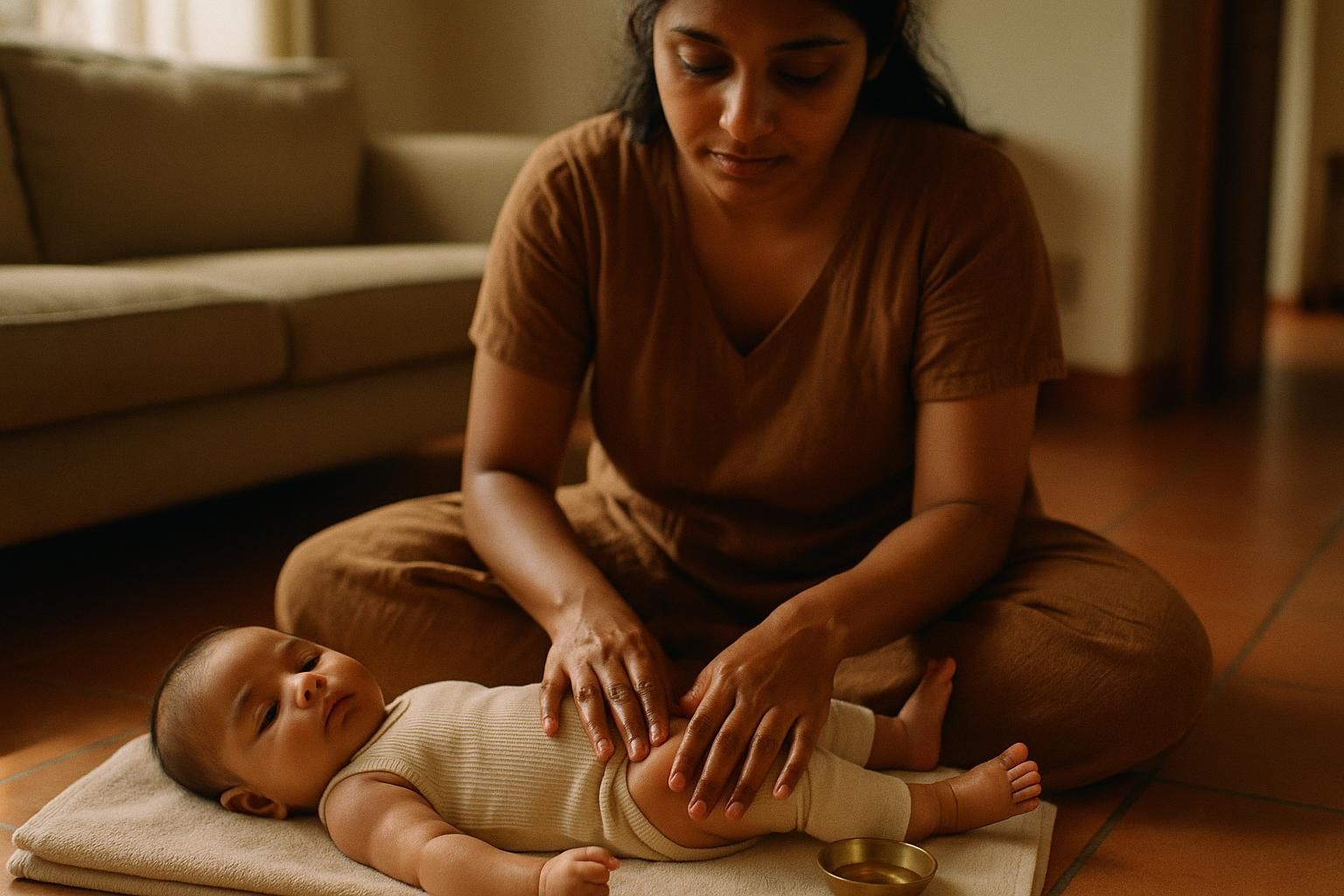
Infant massage is five to ten minutes of slow, oiled strokes over your baby's body. Usually before the bath. Usually on the floor, with the baby lying on a towel or across your legs.
It's the thing that happens in South Asian homes every evening, that nobody writes down because nobody needs to. It's also the whole reason Nani's Hands exists — to keep it, and to hand it to parents who are raising children a long way from the people who would have shown them.
What does infant massage actually involve?
A warm room, warm hands, and a little plain oil. Long unhurried strokes down the arms and legs, out across the chest, slow circles on the tummy, then the back — the stroke most families reach for when a baby is windy or colicky. You go slower than feels natural; most people start far too fast.
Your baby will tell you when they've had enough: squirming, arching, turning the head away. That's the end of the session, whether you're four minutes in or forty seconds.
Every routine we publish is built from these same infant massage techniques. Ours puts them in order and takes you through one at a time, so you're not trying to remember what comes next while holding a baby. Learning how to massage a baby takes an evening, not a course.
When can you start baby massage?
Once the umbilical stump has healed and your baby is feeding and settled.
In South Asia it begins far earlier than Western guidance suggests. In Bangladesh, 80% of newborns have had their first oil massage within four days of birth; in Nepal, 99.7% within the first two weeks.
If your baby was premature, or has a skin or health condition, ask your pediatrician first.
There are ordinary days to skip as well — a fever, the days after an immunisation, a baby who is already crying. When not to massage your baby has the full list, and the traditional practices we leave behind.
We wrote our routine for those early months in particular — the stretch when you have the least time, the least sleep and the least confidence that you're doing any of it right.
How often, and for how long?
Once a day is plenty. Five to ten minutes is plenty. In most households that practise it, newborn massage happens daily and runs into the bath and then sleep — the sequence matters more than the length.
That's exactly why we kept ours to five minutes. Something you'll actually do every evening is worth more than something impressive you manage twice.
What do you need?
- A plain baby massage oil — any edible, unfragranced one
- A folded towel on the floor
- A warm room — warmer than you'd choose for yourself, since the baby will be undressed
- Ten minutes when nobody needs to be anywhere
The oil is the only one of those worth thinking about, and the traditional answers are not all good ones. Which oil to use covers what the skin research supports, and the two that come out badly.
None of it comes from us. This was never a practice that needed equipment, which is part of why it travelled so well — it fits in a suitcase, or in somebody's memory.
Where does it come from?
A long tradition — and, importantly, not a single one.
It gets passed down by touch and by teaching. Mother to daughter, grandmother to mother, somebody's aunt moving your hands into the right position. Nobody wrote it down, because nobody needed to.
Which means there is no one correct version of malish — the everyday word for it across much of North India and Pakistan.
The oil changes by region: coconut oil in Kerala and across the south, mustard oil through the north and Bengal, sesame oil in much of Ayurvedic practice. The order changes by family, and the songs that go with it change by language.
Where this comes from
Right now, somewhere, a woman in her seventies is sitting on the floor with a baby along her legs and a steel bowl of warm oil beside her, and she would be genuinely baffled that you are reading an article about this.
In India, 93.8% of babies under eighteen months are massaged at least once a day, almost all of it with oil. Nobody books it and nobody is certified in it — it's just what you do after the feed and before the bath.
Bhosale et al., BMC Pediatrics, 2020That variety is the whole point, and it's what we're building Nani's Hands around: documenting as many of these routines and practices as we can find, so you can follow the one that suits your family rather than the one that fits a curriculum. If your family has a version of this, we'd genuinely like to hear it.
Does infant massage actually work?
Yes — and what you get is more interesting than the usual promises.
The first thing is the simplest. You're picking up something that has been happening every evening in South Asian homes for a very long time. If you're raising a child far from the people who would have taught you, that on its own is worth the ten minutes.
- Your baby's skin. Oil massage supports the skin barrier — the best-evidenced physical effect, and the reason oil was always part of it
- You, not only the baby. A 2023 systematic review found mother-led infant massage effective for symptoms of postnatal depression. The person doing the massaging gets something out of this too
- Premature babies. Here the clinical evidence is genuinely strong — more weight gain, shorter hospital stays and significantly less infection, in large trials across Bangladesh and India
- A calm point in the day that isn't feeding, changing or damage control. At six weeks in, that is not a small thing
The best way to find out is to try it once. Our Night Calming routine is free, takes about five minutes, and needs nothing you don't already have in the house.
Do you need a class, or a professional?
No. There are baby massage classes and certified instructors, with courses running into the hundreds of dollars, and some people do learn better in a room with a teacher.
But this passed between women in houses for a very long time before there was a curriculum. If your grandmother could learn it standing next to her mother, you can learn it from a guide and ten minutes on the floor. That's what we built our routine to be.
How to start tonight
Pick a time when your baby is calm and it's been at least an hour since a full feed. Warm the room, warm a little oil between your palms, and start with the legs — they're the least sensitive and the easiest place to find your rhythm. Do that much and stop.
When you want the full sequence, our Night Calming routine is five steps and about five minutes, built for one hand on a phone in a dark room. And if you'd rather have the history than the how-to, where this comes from covers the provenance and what we think is worth skipping.
Sources
- Bhosale S. et al., "Prevalence and practices of infant massage", BMC Pediatrics (2020) — N=1,497 caregivers, Maharashtra and Madhya Pradesh
- Darmstadt G.L. et al., on emollient oil therapy and nosocomial infection in preterm infants, trials in Bangladesh and India
- Cochrane review of massage for promoting growth and development in preterm infants — weight gain and length of stay
- Newborn massage prevalence, Bangladesh — Indian Pediatrics (2003)