When not to massage your baby
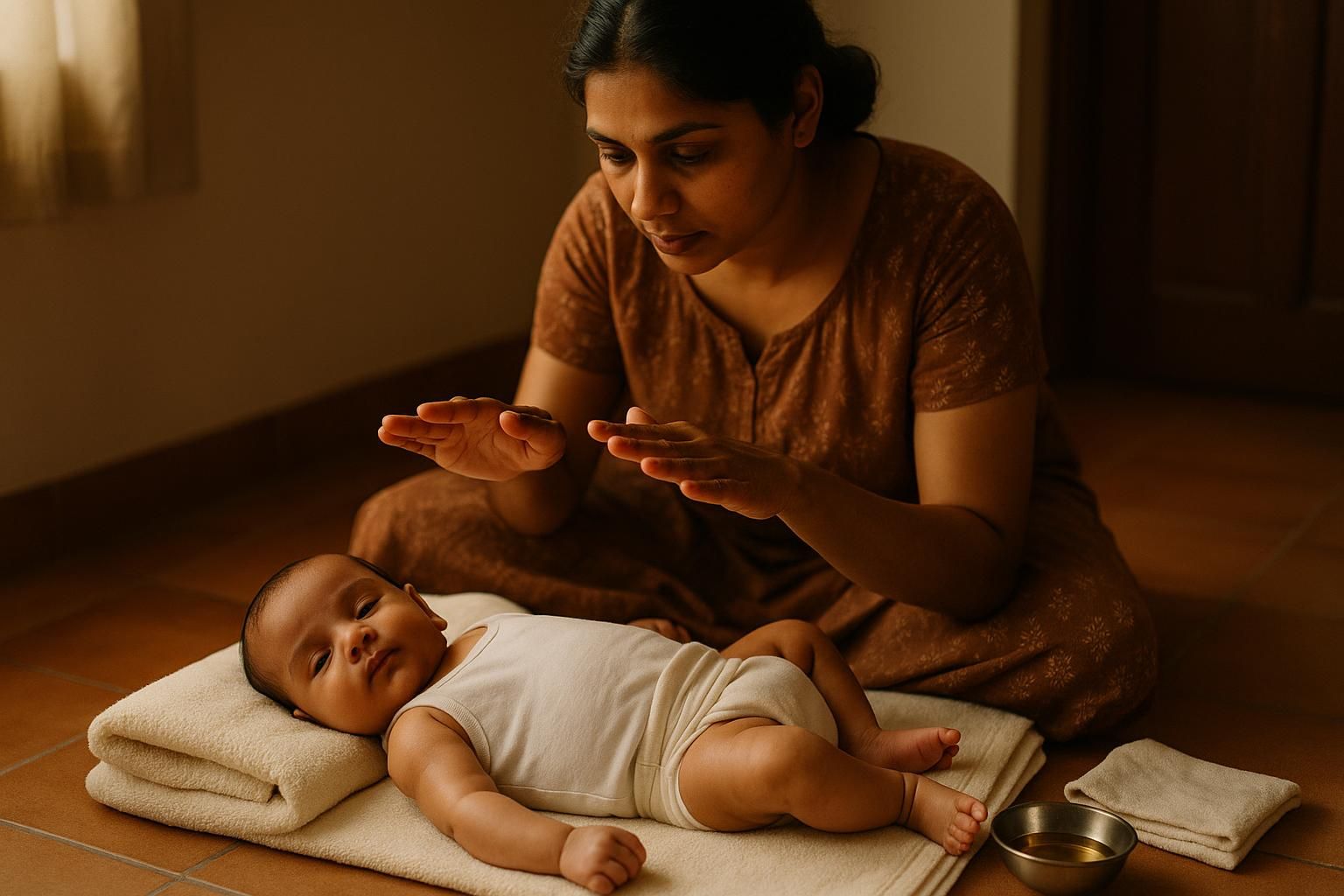
Baby massage is safe. It is also the kind of safe that has a list attached — a handful of days to skip it, a few places not to touch, and a small number of inherited habits that are worth leaving behind.
In a survey of 1,497 Indian caregivers, 95% believed that massage could not cause harm. That belief is the reason this page exists. Almost everything on it is minor, and the few things that aren't are only dangerous because nobody expects them to be.
When should you not massage your baby?
Skip it entirely on these days. None of them are permanent, and none of them mean you've done something wrong.
- During a fever or any acute illness
- Within about an hour of a feed — one to two hours after a full one
- When your baby is hungry, overtired, or already crying
- Over eczema, broken, weeping or infected skin
- Over bruises, swelling, or a known fracture
- On an injection site, or anywhere on the body for about three days after immunisation if your baby is unsettled
- On an unhealed umbilical stump — and keep oil off the tummy until it has healed
- If your baby has a bleeding disorder
- If your baby is premature or medically fragile, until the neonatal team says yes
Our routine opens by asking you to check two of these — the feed and your baby's mood — before the first stroke. It is the least interesting screen we built and the one we were least willing to drop.
How long should you wait after a feed?
About an hour, and closer to two after a full feed.
A full stomach and the downward abdominal strokes parents reach for with colic are a bad combination. The usual result is spit-up rather than anything serious, but a baby who vomits mid-massage learns that this is a thing that happens on the towel.
This is why the traditional sequence puts newborn massage before the bath and after the gap — and why we built the Night Calming routine to sit in the same slot rather than inventing a new one.
Can you massage a baby after a vaccination?
Not on the injection site, and not at all for about three days if your baby is unsettled by the shots.
The leg that was injected is sore. Rubbing it is not a way of dispersing anything; it is pressure on a tender spot, applied by the person your baby trusts most.
We would rather you skipped four nights than pushed through one. Nothing about this practice depends on an unbroken streak, and a site that told you otherwise would be selling you consistency rather than teaching you massage.
Which traditional practices should you skip?
A small number, and it matters that they are named. These are folk additions rather than anything the classical texts prescribe — which means skipping them is not a correction imposed on the tradition from outside.
| Practice | Why we leave it out |
|---|---|
| Forceful limb stretching, joint manipulation, crossing the limbs | A hospital in Uttar Pradesh reported three newborns with a broken thigh bone after forceful oil massage. All three healed within four weeks, and none of it needed to happen |
| Shaping the head, nose or features | No benefit, and a real risk of pain and injury. Head shape changes on its own with normal growth |
| Oil in the nose or mouth | Aspiration and exogenous lipoid pneumonia. In one South Indian series of 69 infants, seven needed ventilation and three died |
| Oil in the ears or eyes | No cleansing benefit. Irritation and contamination risk, and mustard oil is an ocular irritant |
| Deep pressure on the abdomen | Pain, vomiting and physiological stress. Light surface strokes only, well after a feed |
| Squeezing swollen newborn breasts | Tissue damage and infection. The swelling is a hormonal effect that resolves by itself |
| Oil, ghee, turmeric or ash on the umbilical stump | Infection and sepsis risk. The WHO advises clean, dry cord care |
| Hot oil, or massaging beside a heater or fire | Burns and overheating. Warm oil between your own palms — never on a stove or in a microwave |
| Continuing through crying | Crying, arching and splayed fingers are distress signals, not signs that it's working |
Documenting what families actually do, and being straight about the parts we leave out, is the entire job we've given ourselves. If your family's version of malish has something here we've got wrong, tell us — and where this comes from covers the provenance in more detail.
Where this comes from
Your nani would pull the legs long at the end. Straight down, one firm draw each, because straight legs were something you gave a child rather than something they grew into. Her mother did it to her and nobody was ever hurt, which is exactly what makes it hard to stop doing.
It's also the one part we take out. A hospital in Uttar Pradesh reported three newborns with a broken thigh bone, each after a forceful oil massage, and in every one of the three it was the grandmother's. All of them healed within four weeks.
Nothing sits on the other side of that ledger to weigh against it — straight legs were never something a massage could give. Everything else she does — the warm oil, the floor, the daily rhythm, her hands — the evidence supports.
Siddiqui et al., Tropical Doctor, 2020Can you press too hard?
Yes, and the belly is where it matters most.
Everywhere else, too much pressure is uncomfortable rather than dangerous. On the abdomen, deep pressure causes pain, vomiting and measurable physiological stress, and there is no version of baby massage that requires it.
The right amount is less than you think — enough to move the skin, not enough to move what's under it. A class teaches this by putting a hand on your hand, which is the one thing a written routine can't do, so ours errs low and says so at every step.
Which oils should you avoid?
Mustard and olive, as a default. Both are traditional, and both come out badly in the skin-barrier research.
Mustard oil contains a known irritant, has caused contact dermatitis, and offers no established advantage over gentler options. Olive oil reduced skin barrier integrity in trial conditions. The Indian Academy of Paediatrics advises against both, which is worth more here than any Western guidance would be.
Coconut oil is the better default, and sesame oil is worth avoiding on broken or eczema-prone skin because it's a major food allergen. You can also do the whole thing dry — our routine needs no massage oil at all, which is the honest answer to most oil questions.
That is the short version, kept here because an oil question usually arrives as a safety question. The best oil for baby massage is the long one — what the skin research actually shows, and how to pick.
How do you know when to stop?
Your baby tells you, and the signals are consistent enough to learn in a week.
Keep going: relaxed posture, open hands, a softening face, looking towards you, soft sounds, steady breathing.
Pause or stop: stiffening or going floppy, splayed fingers, looking away, frowning, hiccups, repeated yawning, jerky movements, a change in colour, arching, pushing away, crying.
Stop immediately, and get medical help, if your baby goes pale, blue, mottled, clammy, floppy or breathless.
This is the real difference between massage as something you do together and massage as a procedure done to a baby on a schedule. We left the timer out of the routine deliberately — it ends when your baby is finished, not when the five minutes are.
What if your baby was premature?
Ask the neonatal team before you start anything.
This is not caution for its own sake. The strongest clinical evidence for infant massage anywhere comes from preterm babies in hospital, where oil therapy reduced infection substantially — and it was delivered under supervision, to a protocol, by people watching the baby's obs.
Our routine was written for a healthy term baby on a towel at home. That's a narrower thing than the research covers, and it's the honest boundary of what a free guide on a website can be.
So when is it fine?
Most evenings. A warm room, a calm baby, an hour since the last feed, and hands that stop when they're asked to. Knowing how to massage a baby includes knowing the nights to leave it.
If you want the sequence itself, the Night Calming routine is five steps and about five minutes. If you want the ground underneath it, what infant massage is covers the practice, where it came from, and what the evidence does and doesn't support.
Sources
- Bhosale S. et al., "Prevalence and practices of infant massage", BMC Pediatrics (2020) — N=1,497 caregivers, Maharashtra and Madhya Pradesh; source of the 95% figure
- Indian Academy of Paediatrics guidance on newborn skin care, Indian Pediatrics (February 2021) — advises against mustard and olive oil
- Siddiqui S.A. et al., "Femoral shaft fracture following oil massage in neonates: a single-centre experience", Tropical Doctor (2020) 50(4):387–389 — three neonates, Uttar Pradesh; PMID 32664797
- Chetan G. et al., "Oil instillation pneumonia — a social evil", Current Pediatric Research (2009) 13(1) — 69 infants, JIPMER Pondicherry; seven ventilated, three deaths
- Balakrishnan S., "Lipoid pneumonia in infants and children in South India", BMJ (1973) 4(5888):329–331; PMID 4758425
- WHO recommendations on clean, dry umbilical cord care
- Darmstadt G.L. et al., on emollient oil therapy and infection in preterm infants, Lancet (2005)