What is malish? Every household already knows
Tonight, in millions of homes across North India and Pakistan, someone is massaging a baby before bed. Malish means massage, and nobody here is calling it self-care.
Nobody bought a course. It happens the way dinner happens — because it's what you do, every evening, without discussing it first. If you didn't grow up with the word, here's what it means, who's usually doing it, and the one argument every family with a baby eventually has about it.
What does malish mean?
It's the everyday Hindi and Urdu word for massage. For a baby specifically, it means the daily oil rubdown — the whole body, warm hands, before the bath — which is the version we built Nani's Hands to teach, not a shortened one.
It isn't a brand name and it isn't a technique with steps. It's closer to "bath" than to "Swedish massage" — a word for something ordinary, not a method someone invented.
You'll also hear champi, which is specifically the head, and abhyanga, the older Sanskrit term from the Ayurvedic texts. Malish is the word that covers the whole daily thing.
It is also almost universal. One large household survey found 98% of infants in Maharashtra massaged daily, and 85% in Madhya Pradesh — two different states, the same habit either way.
Not a wellness trend. Just Tuesday.
Who does the malish?
Whoever is around and knows how. The mother, most often. The grandmother — paternal or maternal.
Sometimes a dai, the traditional birth attendant who's already in the house for other reasons. And in a lot of urban homes, a hired postnatal masseuse who comes in for the weeks after birth: the malishwali.
Nobody is trained the way a Western instructor is trained. There's no certificate. The line runs mother to daughter, grandmother to mother, and now, increasingly, malishwali to whoever's watching.
One mother on an Indian parenting board pays 3,000 rupees a month for hers — a woman who asks about the bath water temperature, which oil she wants used, and which practices the family doesn't want, and sticks to it.
That's the market rate for the thing we're trying to put in your own hands instead.
What does a malish session actually look like?
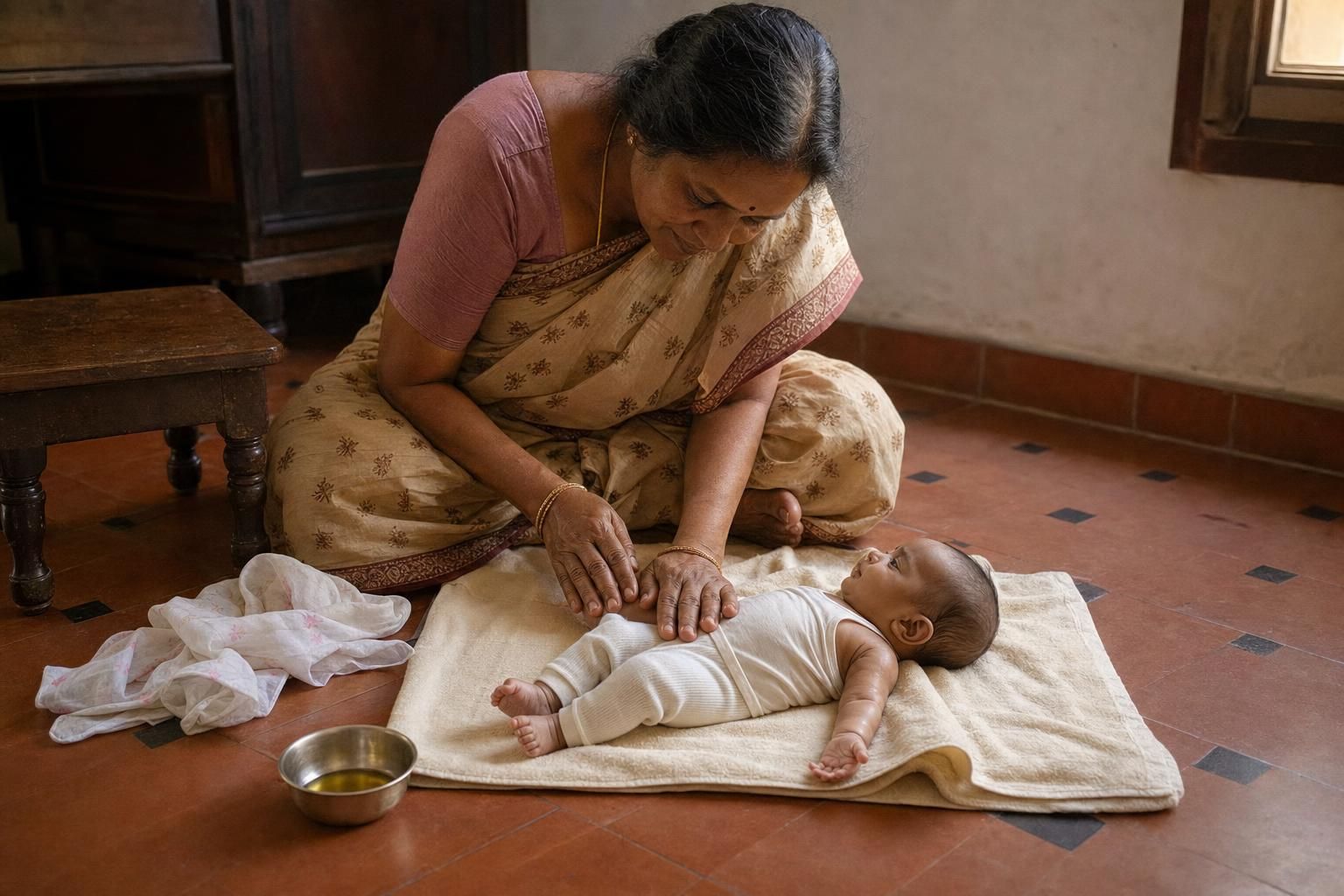
A steel bowl of oil, warmed between two palms. A folded towel on the floor. Ten to twenty minutes, usually before the evening bath, baby lying along someone's outstretched legs.
One mother put it flatly, describing why she does it herself rather than handing it to anyone else: the technique can be learned, it's not a big deal, and it turns into the part of the day her baby actually looks forward to. Another still has the photos and videos from doing it with her sister every evening. "I'm missing it now," she wrote, years later.
That's the whole shape of it. No equipment beyond a bowl and a towel, which is why our own Night Calming routine asks for nothing you don't already have on the shelf.
Should you hire a malishwali, or do it yourself?
Either can be fine. The evidence has a mild preference for you.
A familiar caregiver doing the massage is the version the research actually supports — not because a paid masseuse is dangerous by default, but because a parent's hands come with voice, gaze and the ability to read what the baby wants, in a way an untrained stranger's don't automatically.
The forum arguments track the same split, minus the caveats. One mother kept two malishwalis over five months and says both worked too fast and her daughter cried through every session — her advice afterward was blunt: do it yourself.
Another raised a hygiene objection specifically, about hands and nails between clients. A third put it simply: "the way we love, care our kids no-one else can."
And then there's the version where nobody was available to teach it at all. One mother, with no family support on either side, hired an aunty for a single month, sat and watched everything she did, and then did the malish herself for the whole first year. That's the pattern underneath all of it — somebody older shows somebody younger, once, and it sticks.
Is malish the same thing as baby massage?
Practically, yes. What's different is how ordinary it is where it comes from.
"Baby massage" in the West usually means a class, a course, a thing you opt into. Malish was never opted into — it's closer to how nobody "opts into" bathing a baby.
If you want the fuller picture of what the practice is and what the evidence actually shows, what infant massage is covers that ground properly. If it's specifically the oil question, that's its own post.
Where this comes from
The line runs mother to daughter, grandmother to mother — not through a school. In Indian households, that's the mother, the paternal grandmother or mother-in-law, sometimes a dai, and now often a hired malishwali standing in where the family used to.
Which is exactly what happened to one mother writing about her first baby. No grandmother nearby, no aunts down the hall — nobody in the country, really, who could just show her. So she hired someone for a month, sat on the floor and watched every session, and then spent the next year doing it herself.
That's not a workaround. That's the actual mechanism — it has just as often run through a malishwali as through a grandmother's kitchen.
The hands change. The showing-someone-once doesn't.
Bhosale et al., BMC Pediatrics, 2020What if nobody ever showed you?
Then you're the reason this site exists.
A lot of us are raising babies a long way from whoever would have done the showing — a different city, a different country, a phone call instead of a floor to sit on together. The steel bowl and the folded towel travel fine. It's the hands-on part that doesn't survive the move on its own.
That's what the Night Calming routine is for — not a class, not a certificate, just the thing someone would have shown you if they'd been in the room. And if your family's version of malish looked different from what's here, tell us about it — we'd genuinely like to know.
Sources
- Bhosale S. et al., "Prevalence and perceptions of infant massage in India", BMC Pediatrics (2020); PMID 33167905 — N=1,497 caregivers, Maharashtra and Madhya Pradesh; prevalence and household roles