A five-step massage to settle a baby at night
There's a five-minute baby massage that fits in the hour before bed. Five steps, a folded towel, a little warmed oil. It's the same shape of thing that happens in most households across South Asia every evening, and it is not a way to make your baby sleep through the night.
Both halves of that matter. The routine is worth doing and the promise attached to it online is oversold, so this page gives you the steps and the verdict in the same place.
Does baby massage actually help babies sleep?
Not in the way most of the internet says it does.
The largest review of the research looked at massage in healthy babies under six months and found nothing that held up. The promising results kept disappearing once the weaker studies were set aside.
So it won't add hours to a night, and anyone promising you that is ahead of the evidence.
What's left is still worth ten minutes. A quiet, low-stimulation, predictable block at the same point every evening is a reasonable thing to give a baby, and some parents find it helps their baby wind down.
That's a bedtime cue, not a sleep intervention, and the distinction is why we called ours the Night Calming routine rather than a sleep routine. The other word would have brought us more traffic.
When in the evening should you do it?
Before the bath, and about an hour after a feed.
The widely reported household pattern across India and Bangladesh is massage, then bath, then bed — the massage is the first thing in the sequence, not the last. It gives you a fixed point to hang it on that doesn't need inventing.
Leave an hour after a feed, and closer to two after a full one. A baby who spits up mid-massage learns that this is a thing that happens on the towel, and the days to skip it entirely are worth reading once before you start.
Our routine was built to sit in that existing slot rather than ask you to clear a new one. Nothing that needs a new slot in the evening survives the third week.
What do you need before you start?
A warm room, a folded towel on the floor, and a little oil. That's the list.
Warm the oil by rubbing it between your palms rather than heating it. Warming your hands and showing them to your baby before the first touch is part of the standard teaching, not a flourish. Which oil matters more than people expect, and mustard and olive are the two to leave out.
No mat, no music, no app, no equipment. We wrote our routine with nothing to set up because the version of this that actually gets done on a wet Tuesday is the one you can start in eight seconds.
Where this comes from
In the house this comes from, nobody calls it a sleep technique. It's what happens before the bath, the way the bath is what happens before bed. No timer, no claims, and a steel bowl that lives on the same shelf it has always lived on.
Nagamani Podri, 35, does postnatal massage for mothers and babies in Hyderabad alongside her work as a domestic worker. She has no formal training. She learned it from her mother and has done it for all four of her own children.
That's how it moves — mother to daughter, grandmother to mother, by watching someone do it. Nobody in that house has a certificate. In the West the same five minutes is taught on courses running to several hundred dollars.
Naidu V., The Juggernaut, April 2024How do you do the five-step massage?
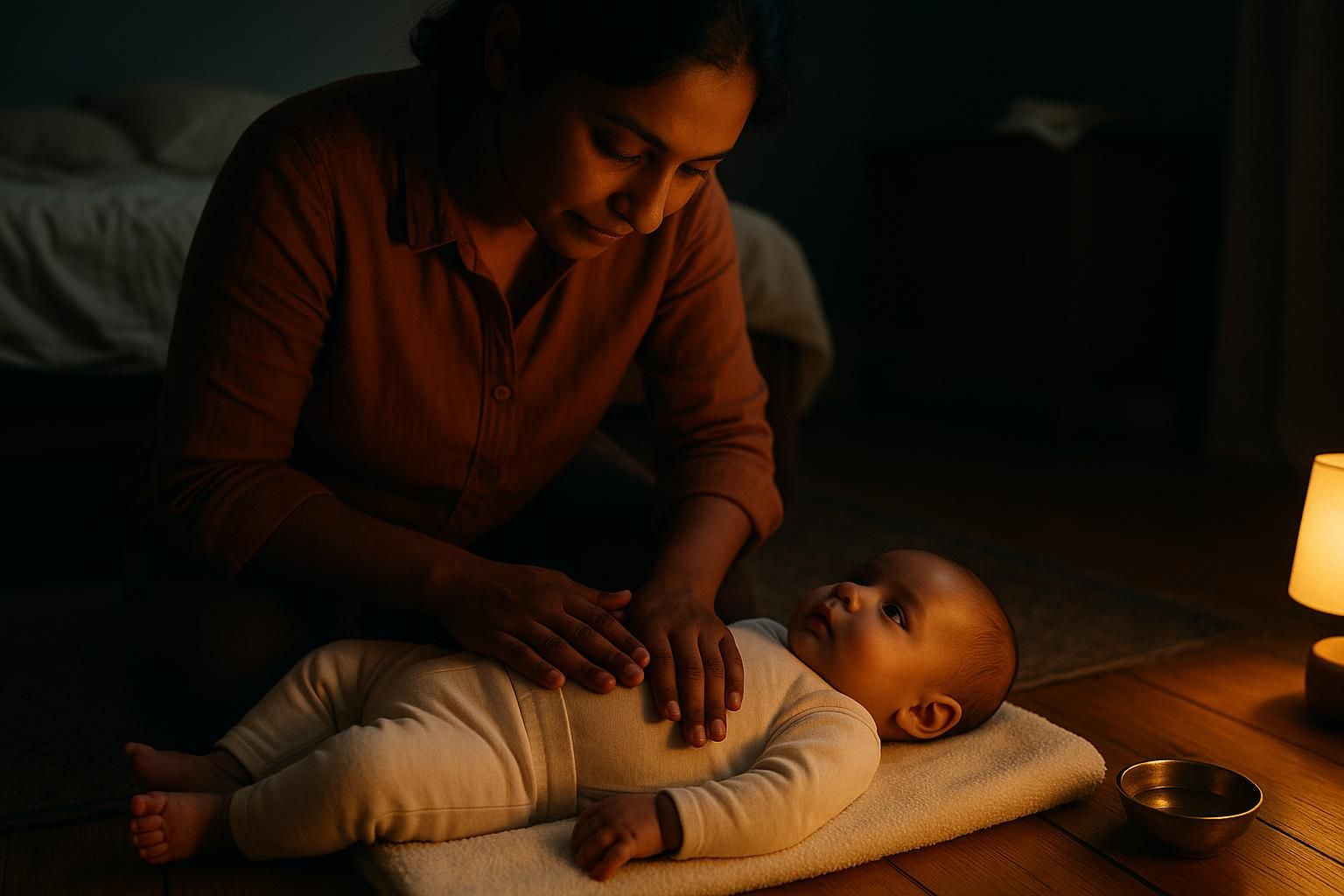
Top to bottom, slowly, ending where you started. Baby on their back on the towel, you sitting or kneeling beside them, the light already low.
1 · Containment hold
- One hand laid flat across your baby's chest
- The other on their lower torso or hips
- Hold completely still — no stroking yet
- Five slow breaths together
Still, steady pressure is the least stimulating thing you can do with your hands, which is why it opens and closes the routine.
2 · Chest open
- Both hands on the centre of the chest
- Sweep gently outward to the shoulders
- Very light, very slow, pausing between strokes
- Three to five times
3 · Arm glide
- Support one arm gently
- Glide from shoulder down to wrist
- Two or three times per arm
- Keep the arm close to the body — no lifting, no stretching
4 · Leg milking
- Wrap your hand softly around one thigh
- Glide slowly down to the foot
- Three times, then the other leg
- Stay close to the body — never pull a leg straight
5 · Stillness close
- Back to the containment hold
- Hold still, breathe slowly
- Drop the light a little further
- Stay as long as it's working
That's the whole five-step routine. It runs about five minutes at a normal pace, and the guided version with a voice track is the Night Calming routine.
Why do the steps go in that order?
Because each step adds less than the one before it, and the last one adds nothing at all.
You open with stillness because there's nothing to process. Then broad slow strokes, then the limbs one at a time, then stillness again. A baby who is already halfway to sleep by step four should not meet something new at step five.
Speed does more work than pressure. Researchers at Oxford found that stroking a baby's skin at about three centimetres a second measurably dulled their response to pain — and that the speed was the part that mattered, not simply the touch.
Three centimetres a second is slower than feels natural. It's the one number worth keeping in your head.
The feet come last, or not at all at night, which is a subject of its own. We wrote the order down and published it because the person who would have stood over your shoulder and shown you isn't in the room.
How do you know when to stop?
Your baby will tell you, and the signals are consistent enough to list.
Keep going: relaxed posture, open hands, looking toward you, a softening face, soft sounds, steady breathing.
Pause or stop: stiffening or going floppy, splayed fingers, looking away, frowning, hiccups, repeated yawning, jerky movements, arching, pushing away, crying.
This is the difference between a massage done with a baby and one done to them. We left the timer out of the routine on purpose — it ends when your baby is finished, not when five minutes are.
How long before it makes a difference?
Give it two or three weeks, and judge it on the evening rather than on the night.
A cue works by repetition. The first few nights it's a novel thing happening to a baby at bedtime; by the third week it's the thing that comes before bed, which is the only mechanism anyone can honestly point to here.
It isn't a treatment for colic either. The one finding with real ground under it points at you rather than at your baby: mothers who massage their babies report fewer symptoms of postnatal depression, and that result is steadier than anything on the sleep side.
That's the honest version, and it's written for the person actually doing it: one parent, one baby, a towel, seven o'clock. If you want the ground underneath the practice, what infant massage is covers where newborn massage came from and what the evidence does and doesn't support. Knowing how to massage a baby is mostly knowing what not to expect from it.
Sources
- Bennett, Underdown and Barlow, Cochrane Database of Systematic Reviews (2013) — massage in typically developing infants under six months
- Gursul et al., Current Biology (2018) — University of Oxford; stroking speed and infant pain response
- Geary, Grealish and Bright, PLOS ONE (2023) — University of Limerick; mother-led infant massage and symptoms of postnatal depression