
Does infant massage actually help colic?
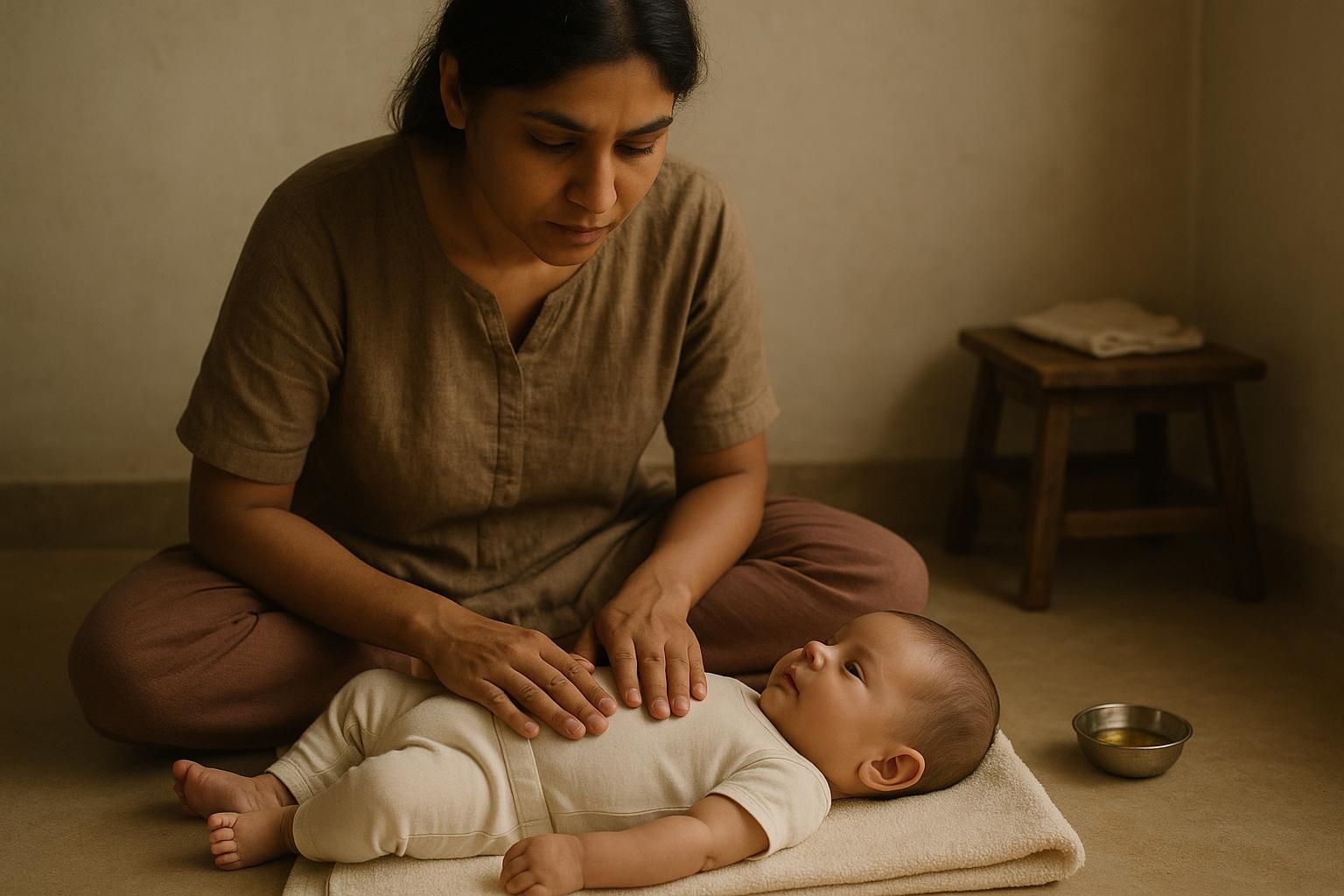
Somebody has told you infant massage cures colic. Somebody else has told you it's snake oil. You are standing in your kitchen at midnight holding a screaming baby, and you would like, please, an actual answer.
Here it is, honestly: infant massage for colic does not cure colic. But that's not the same as saying it does nothing, and the difference matters more than the headline.
Does infant massage cure colic?
No. Not in anything that held up under a second look.
The best available review looked at massage in healthy babies under six months — crying, fussing, sleep, the lot. Every result that looked promising early lost its significance the closer anyone looked. Nothing survived.
That is a genuinely different finding from "no evidence." It means the question has been asked, more than once, with real controls. The answer came back no.
It's also why we don't sell our own routine as a cure. The evidence doesn't say that, so neither do we.
So why does it feel like it works?
Because something did happen. Just not what you think.
A baby who has been bicycled, circled and held for ten minutes is a baby who has been handled, warmed, and taken somewhere quieter than wherever they were screaming. Wind moves on its own timetable. Sometimes it moves during those ten minutes, and you were doing something with your hands when it did.
On an Indian parenting forum, one mother reassured another, worried her gassy baby wasn't improving, that massage "will help in decreasing the colic pain... and also will help in giving proper sleep." That's more certainty than any trial can back.
It's also not really a medical claim. It's one tired parent telling another what got them through the evening — which is a completely different, and completely valid, thing to say.
It's the case we make for our own routine, too. Not a cure. Ten calm minutes with your hands.
Where does the real evidence live, then?
Hospitals. Premature babies. Not your living room.
The genuinely strong results are daily oil massage for preterm infants in South Asian neonatal wards. A large Bangladesh study found a 41% drop in serious infection from sunflower-seed oil massage alone, against standard care. That is a real, repeated, hospital-grade finding.
It is also a different population entirely. A five-pound baby in an incubator and a healthy nine-pound baby with trapped wind are not the same question, and a result from one does not transfer to the other. Our own routine is built for the second baby — healthy, term, at home — not the ward.
Then what's actually worth doing it for?
You, more than the baby.
A 2023 review looking specifically at mothers doing the massage themselves found it eased their own symptoms of postnatal depression. A small, scattered body of work, but a consistent direction — the massage did something measurable for the person giving it.
That is worth sitting with. The product on this site is a gas-relief routine, and we could sell it on a colic cure it doesn't have. We'd rather sell it on the thing it actually does: ten minutes where you are doing something useful with your hands instead of standing in the kitchen feeling helpless.
Where this comes from
One mother on Reddit hired a malishwali for her son, colicky, with reflux, and kept her on through six months. The baby settled into the massage and the bath.
She was clear-eyed about it the whole time: she doesn't think it made him stronger. Just calmer, and on a routine.
That is close to the exact shape of what the evidence supports, arrived at without reading a word of it. Her only rule was boundaries: "Make sure you lay your boundaries strictly and never leave the baby alone with them."
93.8% of Indian infants are massaged at least once a day, and nobody in those houses is arguing about statistical significance. They are doing what that mother did — something with their hands, calmly, on a schedule, because a baby handled gently every day is easier company than one who isn't.
Is it worth doing anyway?
Yes, with the claim taken off the label.
Ten minutes of legs, tummy circles and a held position costs you nothing a baby can't spare, kept gentle and clear of the reshaping and hard pressure the safety page covers. If it happens to move some wind, good. If it doesn't, you've still spent ten minutes handling your baby calmly instead of pacing with them.
What it is not is a substitute for checking the things that actually treat colic-like crying — reflux, a milk intolerance, a feeding problem. If nothing changes after a couple of weeks of trying, that's a question for your GP, not a reason to press harder.
For the actual sequence — legs before belly, how hard to press, what to do when a baby refuses it — the full colic massage covers the how. This page was only ever about the whether.
Sources
- Bennett, Underdown and Barlow, Cochrane Database of Systematic Reviews (2013) — massage in typically developing infants under six months, including crying and fussing
- Darmstadt et al., The Lancet (2005) — sunflower-seed-oil massage and infection reduction in preterm infants, Dhaka
- Geary, Grealish and Bright, PLOS ONE (2023) — mother-led infant massage and maternal postnatal depression symptoms
Parent accounts are from public posts on Indian, Pakistani and British parenting forums and Reddit, collected in our own research files. They record what parents report, not what has been demonstrated.