The colic massage, in the order it actually goes
It is eleven at night. The baby has been rigid for forty minutes, your phone is on speaker on the floor, and somewhere on the other end an aunt is explaining what you should be doing with your hands. This is when most people meet the colic massage, and it is the worst possible moment to learn anything.
So here it is in daylight. Seven steps, about ten minutes, legs before belly. Plus the two questions nobody answers straight — how hard to press, and what to do about everything else being pushed at you.
Does massage actually help colic?
No. Not colic, not the way that word is used.
The best review of massage in healthy babies looked at crying and fussing and found nothing that survived a second look. A paediatrician, quoted by a mother on an Indian parenting forum, put it more usefully than any of the literature: do it if you want, but don't kid yourself it is more than routine and relaxation.
What parents report is smaller and much more specific. Wind moves. Fifteen years of forum threads on this are essentially one long, delighted record of babies farting — "she let out 3 farts, ate a bit more, and self soothed to sleep" is a completely typical evening.
Ten minutes for that is a fair trade with no trial behind it. It is also why we built a Gas Relief routine and never once put the word cure near it.
When in the day should you do it?
An hour after a feed. Before the screaming, not during.
Full stomach plus firm downward strokes is how you get spit-up down your forearm. Leave an hour, nearer two after a big feed, and read the days to skip it entirely now, while nothing is on fire.
The part nobody wants: a baby already mid-scream is a bad candidate. Catch the squirming, the knees drawing up, the fifteen seconds where they are still negotiable — that is your window. Past it, put the oil down and just hold them.
What is the full colic sequence?
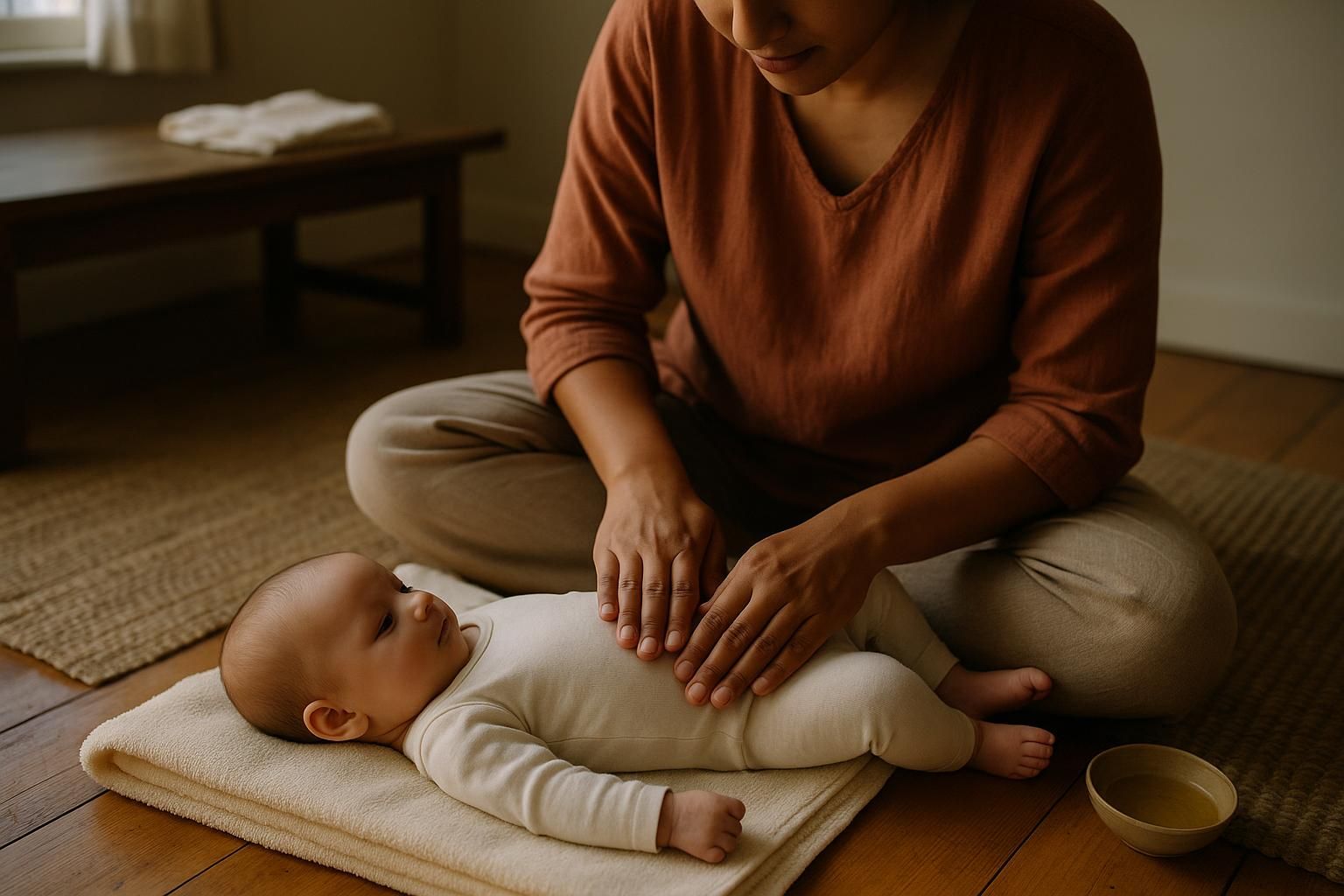
Seven steps, legs before belly. Baby on their back on a folded towel, room warm, hands warmer.
1 · Containment hold
One hand flat on the chest, one on the lower belly. Still. Five slow breaths.
You haven't started — you're knocking.
2 · Leg warm-up
Slow strokes down each leg, hip to foot. Loosens the hips, makes room for anything to move. Going straight for the belly is the commonest mistake there is.
3 · Bicycle legs
Slow, even cycling, one leg then the other. The movement does the work. The force behind it does nothing.
4 · Tummy circles
Flat fingers, low on the belly, clockwise as you look down at them. That is the direction the large intestine runs. Of everything on this page, it is the one detail to get right.
5 · Knees to tummy
Both knees folded gently up, held a few seconds, released. Again. You are not pushing anything out — you're loosening the hips and letting the belly do its own compressing.
6 · Tiger in the tree
Baby face-down along your forearm, your hand between their legs taking the weight of the belly, head at your elbow. Gravity does it and you do nothing. This is the one to reach for when the belly work is being refused.
7 · Side-lying release
On their side, curled, your hand on their back. The ending — and the position most of them settle into anyway.
That is the full sequence, guided with a voice track in the Gas Relief routine. The "I Love You" strokes everyone mentions are one way of shaping step four. They get their own post.
How hard should you press?
Hard enough to move the skin. Not hard enough to change the shape of the tummy under your hand.
You will be told otherwise, probably at volume. This argument runs and runs on the Indian and Pakistani parenting forums, and it is not the polite disagreement it sounds like.
One mother describes the maalish for her one-month-old as "rough and hard and apparently that's how they do it". They stopped, and took over themselves. Another watched a neighbour's newborn massaged hard enough to strain the baby's shoulder.
And yet it is not tradition versus caution, which is the genuinely interesting part. Plenty of the same mothers defend a good malishwali — "highly underrated", says one, whose baby has two a day and loves them.
The line is drawn at force and at reshaping. Never at the practice.
So our guidance sits at the gentle end on purpose. Not squeamishness: a hospital in Uttar Pradesh reported three newborns with a broken thigh bone after forceful oil massage. A massage that does slightly less than it might have is a trade we will take every single time on a one-month-old.
Where this comes from
The moment a South Asian baby has wind, a paste appears. Heeng — asafoetida — mixed with warm water, put on the tummy or around the navel, sometimes a warm compress after, usually the legs cycled at the same time.
Two mothers on an Indian parenting board give it in the same breath as the cycling, as though it were one instruction. In that house it is.
We keep the cycling. We leave the paste. Nothing goes on a navel while the cord stump is healing — the WHO is unambiguous about that one — and once it heals, the heeng still isn't doing what your hand is doing.
A father in Rajkot, arguing on Reddit against hiring anyone in, got nearer the principle than we have managed: "instead of people experimenting on my baby it's better if we parents experiment." He then listed the customs he had dropped, on the grounds that nobody could tell him what a single one of them was for.
He kept the massage. That is the sorting all of us are doing, and he is doing it more honestly than most.
What about heeng, gripe water and the rest?
It arrives all at once, usually while you are holding a screaming baby with one arm.
One Indian mother's list for a single evening: gas drops, gripe water, probiotics, clockwise circles, bicycle legs, knees to chest. That is not an unusual night. Gripe water on its own deserves a post rather than a line here, and it will get one.
Two rules make the pile manageable. Anything that goes in or on your baby is a question for your GP, not for a forum and not for us. Anything you do with your hands, you can try tonight and judge yourself by morning.
This page only covers the second sort. Narrower than most sites promise, which is exactly why we can keep it.
What if it isn't working?
Change the position. Do not press harder.
Some babies lock their knees and simply will not be cycled. One mother whose daughter did precisely that found the answer was sliding a palm underneath and lifting the pelvis from below — no bending, no compression, instant relief. Another gave up on the belly altogether and does the feet, on the theory that a calm baby sees to its own wind.
Step six is in our routine for this. Tiger in the tree uses gravity and your forearm instead of your hands, and it still works on the babies who have refused the other six.
And some want none of it, ever. Stiffening, arching, splayed fingers, looking away, crying that gets worse the moment you start — that is a no.
One mother compared massaging her daughter to "trying to hold on to a greasy little piglet" and stopped. Correct call.
How long before it makes a difference?
One session, if at all. The wind moves or it doesn't — nothing here quietly compounds over six weeks.
What does build is your hands. By the third go you have stopped reciting the order and started watching the baby, which is the whole skill and takes about a week. It is why a mother in Canada, doing it herself for two children with no help and no maalish wali she could afford, could write "koi rocket science nhe hai" and be completely right.
Colic ends on its own schedule anyway, somewhere around three or four months, and none of this changes that. What it gives you is something to do with your hands until then. On the fourth bad night running, that is not nothing.
For the ground underneath the practice, what infant massage is covers where newborn massage came from and what the evidence supports. For the calm evening version instead of the emergency one, the five-step wind-down is this sequence's better-rested sibling. Knowing how to massage a baby is mostly knowing which of the two tonight is.
Sources
- Bennett, Underdown and Barlow, Cochrane Database of Systematic Reviews (2013) — massage in typically developing infants under six months, including crying and fussing
- Siddiqui et al., "Femoral shaft fracture following oil massage in neonates", Tropical Doctor (2020) — three neonates, Uttar Pradesh
- WHO recommendations on clean, dry umbilical cord care
Parent accounts are from public posts on Indian, Pakistani and British parenting forums between 2011 and 2026, collected in our own research files. They record what parents report, not what has been demonstrated.