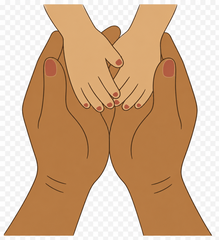
Newborn foot massage, and why feet come last
Newborn foot massage is the same slow, oiled stroking as the rest of the routine — same oil, same towel, same unhurried pace. In most versions taught today, the feet are where the whole thing begins.
In the one we built for bedtime, they're the part saved for last, or left out entirely. Both are correct. Which one you want depends on whether it's four in the afternoon or eight at night.
Why do most baby massage routines start at the feet?
Because it's the easiest place to begin. A baby can watch your hands the whole time, nothing is happening near the face, and the sequence most instructors still teach was written down after watching it done exactly that way, every day, in someone's home.
Vimala McClure was in her early twenties when she spent time at an orphanage in northern India in 1973 and watched staff massage infants as a matter of course, not as a wellness trend. Legs and feet first, then the stomach, chest and arms, then the face and back. She wrote that order down and it became the backbone of the standard Western training curriculum.
Across South Asian households, none of this reads as a method. It's what a grandmother does before the bath, in the order her hands have always worked, to a baby who's usually too young to have an opinion about it yet. Our own five-step night routine breaks from that order on purpose, and that break is the part worth explaining.
Where this comes from
Nobody in that orphanage was teaching a technique. They were doing the thing their own mothers had done to them, on a floor, with warmed oil, starting at the feet because that's simply where the hands went first.
The instructor manuals, the certification programme, the "developmental sequence" — all of that came after, built in the West around a practice that had been ordinary in Indian homes for generations before anyone wrote it down.
McClure V., Infant Massage: A Handbook for Loving Parents, 1978So why do feet come last in a bedtime massage?
Because the sole of a newborn's foot is the most reflexive patch of skin on their body, and a routine built to wind a baby down shouldn't end on the one touch most likely to wake them back up.
Stroke the bottom of a newborn's foot and their toes fan out and their leg often draws up — the Babinski reflex, present from birth and normal until roughly two years old. It's an involuntary nervous-system response, not a reaction to discomfort, but it's still a jolt of activity in a baby you're trying to settle.
A 2022 study out of Boston Children's Hospital measured exactly this: touch applied to an infant's foot reliably produces a stronger, more coordinated leg-withdrawal response than the same touch almost anywhere else on the body. The foot isn't just sensitive. It's wired to react.
That's the whole logic behind our Night Calming routine, where the feet come last, or get skipped once a baby's already drowsy. It's the same oiled stroking as newborn massage anywhere else on the body — just moved to the end of the queue instead of the front of it.
Is it safe to massage a newborn's feet?
Yes, for almost every baby, almost every day. Every grandmother who's done this for forty years will tell you the same thing before you ask.
The usual caution applies: skip it on the days covered in when not to massage your baby — fever, a rash on the foot itself, a recent vaccination in the leg. Otherwise a newborn's foot takes the same gentle oiled stroke as everywhere else, no firmer and no more delicate.
One thing worth knowing before you start: pressing directly and firmly into the centre of the sole is more likely to trigger that reflex response than a broad, gliding stroke is. Neither is dangerous. One is just calmer.
A startled kick or a fanned-out set of toes isn't your baby telling you to stop. It's a nervous system doing exactly what it's supposed to.
How do you actually massage a newborn's foot?
Warm a little oil between your palms first — never straight from the bottle onto skin, and never heated on the stove. Which oil you use matters more than people expect.
- Cup the foot gently in one hand, heel resting in your palm
- With the other hand, stroke from the ankle down over the top of the foot to the toes
- Circle each toe once, lightly, between thumb and finger
- Finish with a broad, flat stroke across the sole — not a poke, not a press, just a glide
- Two or three passes, then move on, or stop there if it's the last step
That's the whole technique. It's still newborn massage — the same oil, the same unhurried hands — just narrowed down to one small, ten-toed part of the body.
What if your baby squirms, laughs, or pulls their foot away?
Then you've found a ticklish baby, which is common and not a reason to stop unless the squirming turns into real distress.
One parent on Reddit started foot massages purely to help her son sleep. By eighteen months the job had changed entirely — he'd lie there pointing at whichever body part he wanted done next, four seconds between each request, dragging the whole thing out by forty minutes. Her verdict on how the arrangement turned out: "I find the shifts to be stressful, poorly compensated and a very demanding client."
Keep going: giggling, relaxed kicking, watching your face, reaching a hand toward the foot you're working on.
Pause or stop: real crying, arching away, a foot yanked back hard and kept back, or any of the wider signs it isn't the moment. A reflexive twitch is not on that list.
How does this fit into the rest of the routine?
As the last stop, most of the time. Legs, then feet, is how the daytime routine goes — and where we send you back to the full five-step sequence if you haven't read it yet, since this page is really the footnote to that one.
It's the same order our mothers used, oil warmed the same way, just with the ending moved depending on the hour. Four in the afternoon, start at the feet. Eight at night, get there last, or not at all.
Sources
- McClure, V., Infant Massage: A Handbook for Loving Parents (1978)
- Acharya AB, Jamil RT, Dewey JJ, StatPearls (2023) — the Babinski reflex
- Cornelissen et al., PLOS ONE (2022) — Boston Children's Hospital; tactile sensitivity and motor coordination of the infant foot